10 Digital Products You Can Create Using AI Tools (Beginner-Friendly Ideas for 2026)
10 Digital Products You Can Create Using AI Tools (Beginner-Friendly Ideas for 2026)
AI has quietly removed the two biggest barriers that used to stop people from building a digital product business: time and technical skill. A few years ago, launching an ebook, a course, or a template system meant hiring writers, designers, and sometimes developers, or spending months learning those skills yourself. In 2026, one creator with the right AI tools can research, write, design, and package a digital product in days instead of months.
The numbers show how fast this shift is moving. According to McKinsey’s 2025 Global Survey on AI, 71% of organizations now use generative AI regularly in at least one business function, more than double the 33% reported when McKinsey first asked the question in early 2023. On the individual side, AI tools collectively reached 378 million users worldwide in 2025, the largest year-over-year jump on record. The creator economy has expanded right alongside this boom, with 2026 market size estimates ranging from roughly $205 billion to $250 billion and several forecasts pointing toward $480 billion or more within the next few years. Small businesses are adopting just as quickly: U.S. Chamber of Commerce research found generative AI usage among small businesses jumped from 40% to 58% in a single year, and most AI-using small businesses now report measurable productivity or revenue gains.
For creators specifically, the impact is direct. Industry data suggests AI tools can cut content and course production time by 40-60%, and the majority of independent course creators now use AI somewhere in their workflow. For beginners, freelancers, and side-hustlers, one of the most realistic ways to make money with AI right now is to package your existing knowledge into a digital product you can sell repeatedly, with AI doing the heavy lifting on research, drafting, and design.
This guide covers 10 beginner-friendly AI entrepreneur ideas, specific digital products you can create in 2026:
- AI-powered ebooks and guides
- AI prompt packs
- Canva templates and design assets
- AI online courses
- Business templates and systems
- AI image prompt libraries
- Notion AI templates
- AI content packages
- AI career products
- AI automation kits
If you’re new to digital products altogether, our guide on How to Build and Sell Digital Products covers the fundamentals of pricing, platforms, and positioning. This article builds on that foundation with specific AI business ideas, the AI tools for digital products that make them possible, and the action steps to get your first one to market.
What Are AI Digital Products?
AI digital products are downloadable digital products to sell online, such as ebooks, templates, courses, prompt packs, and automations, created with the help of generative AI tools at one or more stages of production: research, writing, design, or packaging.
Traditional vs. AI-assisted digital products: Traditional digital products required the creator (or a hired team) to manually research, draft, design, and edit every component, often over several weeks. AI-powered digital products use tools like ChatGPT, Claude, and Canva AI to compress that timeline into hours or days, while the creator focuses on direction, quality control, and the expertise that makes the product genuinely useful. The end result looks similar to digital products people have sold for years; what changes is how fast it gets made.
Why AI digital products are scalable: Because the production work is AI-assisted, one creator can build, test, and launch multiple products in the time it used to take to build a single one. A proven framework can become an ebook, a course, a prompt pack, and a content package, all variations of the same core expertise, each created with AI support.
Example: A freelance copywriter could turn their proven email frameworks into a $27 template pack, a $97 mini-course, and a free lead magnet, all created with AI assistance within a single week.
Why Create Digital Products Using AI?
AI doesn’t just speed up digital product creation; it changes what’s realistic for solo creators and beginners.
- Faster creation. What used to take weeks of research and drafting now takes hours. AI handles outlines, first drafts, and formatting, so you spend your time refining instead of starting from a blank page.
- Lower cost. You don’t need to hire writers, designers, or developers for your first product. Tools like ChatGPT, Claude, and Canva AI replace much of that early-stage spend.
- More customization. AI makes it realistic to create niche-specific versions of a product, such as a resume template for nurses versus one for software engineers, without rebuilding from scratch each time.
- Easier testing. Because products can be built quickly, you can launch a minimum viable version, see what sells, and improve it based on real feedback instead of guessing for months before launch.
- Automation opportunities. Tools like Zapier and Make let you automate delivery, follow-up emails, and basic customer support, so your digital product business model runs with less manual work and more room for passive income with AI.
Real-world example: A virtual assistant used ChatGPT to turn their client onboarding process into a $19 Notion template, automated delivery with Zapier, and made their first sales without writing a single line of code.
10 Digital Products You Can Create Using AI Tools
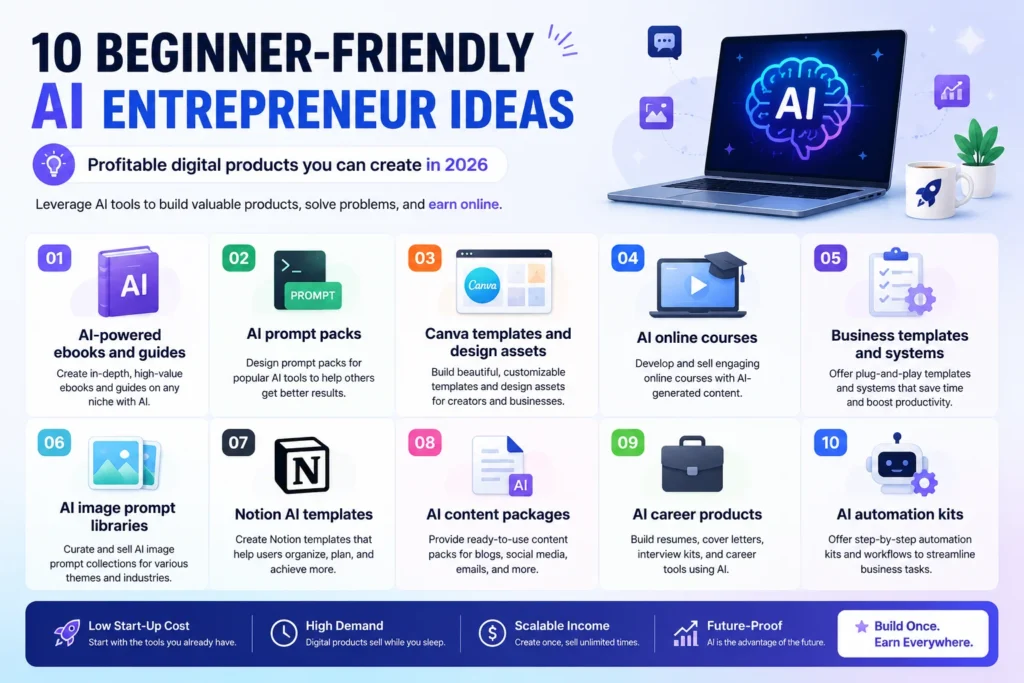
Here are 10 beginner-friendly digital products you can realistically create using AI tools, even with no prior experience in design, coding, or publishing.
1. AI-Powered Ebooks and Guides
Short, focused ebooks (typically 20-60 pages) that teach a specific skill or solve one clear problem, with AI supporting research, drafting, and editing.
Imagine creating a $19 ebook that gives freelance designers a step-by-step system for pricing their first client project. That’s a realistic first product for a complete beginner.
- Who can create it: Anyone with hands-on experience in a topic, including bloggers, consultants, hobbyists, and career changers.
- Target customer: People who want a fast, practical answer to a specific problem rather than a multi-hour course.
- How AI helps: ChatGPT or Claude can build your outline, draft each chapter from your notes, and tighten the language so it reads cleanly.
- Recommended AI tools: ChatGPT, Claude, Canva AI for the cover design, Grammarly for final polish.
- Example product ideas: A 30-day AI marketing playbook, a freelancer pricing guide, a meal-prep system for busy parents.
- Monetization potential: $9-$47 per copy, often bundled with templates for a higher-priced offer.
- Beginner action steps: Pick a problem you’ve personally solved, outline it with AI, draft each section, design a cover, export it as a PDF, and list it on Gumroad.
- Common mistakes to avoid: Publishing unedited AI text, choosing a topic too broad to be useful, and skipping a proper cover design.
2. AI Prompt Packs
Curated collections of tested prompts for ChatGPT, Claude, or Midjourney, organized around a specific use case so buyers get better results without the trial and error.
Imagine creating a $14 prompt pack with 50 ChatGPT prompts written specifically for Etsy sellers, something a beginner creator could put together in a weekend. ChatGPT digital products like this are some of the fastest first products to launch.
- Who can create it: Anyone who has spent time experimenting with AI tools and knows what actually produces good results.
- Target customer: Beginners, freelancers, and marketers who want faster results from AI without learning prompt engineering themselves.
- How AI helps: AI generates prompt variations, helps you test which versions produce the best output, and assists with formatting the final pack.
- Recommended AI tools: ChatGPT, Claude, Midjourney, and Notion for organizing prompts by category.
- Example product ideas: ChatGPT prompts for Etsy product descriptions, Midjourney prompts for brand mood boards, LinkedIn content prompts for coaches.
- Monetization potential: $7-$27 per pack, with higher value when bundled by niche, such as an “Etsy Seller Prompt Bundle.”
- Beginner action steps: Choose one audience, test and refine 30-50 prompts, organize them into categories, and package them as a PDF or Notion doc.
- Common mistakes to avoid: Selling untested prompts, dumping prompts with no structure, and copying prompts that are already widely available for free.
3. Canva Templates and Design Assets
Pre-designed, customizable templates, such as social media posts, presentation decks, and brand kits, built using Canva’s AI design tools so even non-designers can produce professional results.
Imagine creating a $19 Instagram carousel template pack for fitness coaches, designed in an afternoon using Canva’s Magic Design.
- Who can create it: Anyone with a sense of style and basic Canva familiarity. No graphic design degree required.
- Target customer: Small business owners, coaches, and marketers who need consistent, professional visuals without hiring a designer.
- How AI helps: Canva’s Magic Design and Magic Write generate layout options and starting copy that you refine to fit your niche.
- Recommended AI tools: Canva AI (Magic Studio), Adobe Express, Microsoft Designer.
- Example product ideas: Instagram carousel templates, pitch deck templates, brand kit starter packs for new businesses.
- Monetization potential: $9-$49 per template set, sold on Canva’s marketplace, Etsy, or your own site.
- Beginner action steps: Pick one niche aesthetic, design 10-20 templates, confirm each one is fully editable, and bundle them for sale.
- Common mistakes to avoid: Designs that look generic, templates that break when customers try to edit them, and ignoring current design trends.
4. AI Online Courses
Structured, multi-lesson courses that teach a specific skill, built faster by using AI to draft outlines, scripts, slides, and quizzes.
Imagine creating a $49 mini-course that teaches real estate agents how to use ChatGPT for listing descriptions, built around five short video lessons.
- Who can create it: Subject-matter experts, professionals with proven experience, or hobbyists with documented results in their niche.
- Target customer: People who want a guided, step-by-step path to a specific outcome, not just raw information.
- How AI helps: ChatGPT or Claude can structure your curriculum and write lesson scripts, while Canva or Gamma can turn those scripts into slide decks.
- Recommended AI tools: ChatGPT, Claude, Canva or Gamma for slides, Descript for recording and editing video.
- Example product ideas: “AI Automation for Small Business Owners,” “ChatGPT for Real Estate Agents,” “Notion Setup in a Weekend.”
- Monetization potential: $29-$197 per course, depending on the depth and outcome promised.
- Beginner action steps: Define one clear transformation, outline 5-8 lessons with AI, record short videos, and host the course on Gumroad or Teachable.
- Common mistakes to avoid: Cramming in too much content, promising vague outcomes, and skipping feedback from a few beta students before launch.
5. Business Templates and Systems
Ready-to-use templates, such as email scripts, SOPs, onboarding kits, and sales sequences, that save other business owners the time of building these systems from scratch.
Imagine creating a $27 client onboarding kit for coaches, built from a system you already use in your own business.
- Who can create it: Freelancers, consultants, virtual assistants, and agency owners who have already built these systems for themselves or clients.
- Target customer: Solopreneurs and small agencies who would rather buy a proven system than build one from zero.
- How AI helps: AI refines your existing documents into clearer, more reusable templates and generates variations for different industries.
- Recommended AI tools: ChatGPT, Claude, Notion AI, Google Docs.
- Example product ideas: Cold email templates for agencies, an SOP library for virtual assistants, a sales call script pack.
- Monetization potential: $15-$97, with recurring updates offered as a paid upgrade.
- Beginner action steps: Document a process you already use, refine the wording with AI, format it cleanly in Docs or Notion, and package it as a PDF or shareable link.
- Common mistakes to avoid: Templates that are too generic to customize, no instructions for how to use them, and skipping a test run with a real user.
6. AI Image Prompt Libraries
Curated sets of image-generation prompts for Midjourney, Adobe Firefly, or similar tools, built around a specific visual style or business use case.
Imagine creating a $15 pack of 40 product photography prompts that help e-commerce sellers generate clean, studio-style images without a camera or studio.
- Who can create it: Photographers, designers, and marketers who have experimented with AI image generation and know which prompts produce consistent results.
- Target customer: E-commerce sellers, content creators, and small brands that need visuals but can’t afford a photoshoot.
- How AI helps: AI generates and refines prompt variations, and you can attach sample outputs so buyers know exactly what to expect.
- Recommended AI tools: Midjourney, Adobe Firefly, DALL-E through ChatGPT, Leonardo AI.
- Example product ideas: Product photography prompts for e-commerce, branding mood board prompts, social media aesthetic prompt packs.
- Monetization potential: $9-$29 per pack, often purchased alongside design templates.
- Beginner action steps: Choose a visual niche, test and refine 30-50 prompts, document the settings used, and compile everything into a PDF with sample images.
- Common mistakes to avoid: Prompts that don’t reproduce consistently, no example images included, and ignoring the terms of use for each image tool.
7. Notion AI Templates
Pre-built Notion workspaces, such as dashboards, planners, and trackers, enhanced with Notion AI so buyers can customize them immediately after duplicating.
Imagine creating a $24 content planner and client tracker for freelancers, built from the system you already use to manage your own work.
- Who can create it: Productivity enthusiasts, consultants, and project managers who already organize their work in Notion.
- Target customer: Solopreneurs, creators, and small teams who want structure without building a system from scratch.
- How AI helps: Notion AI can draft page content, generate database entries, and summarize information inside the template.
- Recommended AI tools: Notion AI, ChatGPT for copywriting, Canva for icons and cover images.
- Example product ideas: A content calendar and planner, a freelancer CRM dashboard, a business operations hub.
- Monetization potential: $9-$49, sold through Notion template marketplaces and your own site.
- Beginner action steps: Build the system for your own use first, refine it with Notion AI, create a duplicate link, and record a short setup walkthrough.
- Common mistakes to avoid: Overcomplicated templates, no setup instructions, and not testing the template on a brand-new Notion account before launch.
8. AI Content Packages
Bundles of ready-to-use content, such as social captions, post calendars, and email sequences, generated with AI and edited for a specific niche.
Imagine creating a $19 set of 100 Instagram captions for personal trainers, generated with AI and refined to match a confident, motivating tone.
- Who can create it: Social media managers, copywriters, and content creators who understand a specific niche’s voice.
- Target customer: Small business owners and creators who know they need consistent content but don’t have time to write it themselves.
- How AI helps: AI generates first drafts of captions, posts, or emails at scale, which you then edit for accuracy and brand voice.
- Recommended AI tools: ChatGPT, Claude, Jasper, Canva AI for accompanying graphics.
- Example product ideas: A 30-day social media calendar for coaches, a caption pack for fitness brands, an email welcome sequence for online stores.
- Monetization potential: $12-$39 per pack, with monthly content subscriptions creating recurring revenue.
- Beginner action steps: Pick one niche, generate a month of content with AI, edit it for voice and accuracy, and format it as a calendar or document.
- Common mistakes to avoid: Publishing raw AI output unedited, ignoring brand voice, and creating content too generic for the niche it’s meant for.
9. AI Career Products
Resume templates, cover letter frameworks, and interview prep guides built with AI to help job seekers present themselves more effectively.
Imagine creating a $17 ATS-friendly resume template pack with AI-generated bullet point examples for common job titles in a specific industry.
- Who can create it: HR professionals, recruiters, career coaches, and anyone who has successfully navigated a competitive job search.
- Target customer: Job seekers, career changers, and recent graduates applying through applicant tracking systems.
- How AI helps: AI tailors resume language to specific roles, generates practice interview questions and sample answers, and helps format documents for ATS compatibility.
- Recommended AI tools: ChatGPT, Claude, Canva for resume design.
- Example product ideas: An ATS-friendly resume template pack, an AI interview prep guide for tech roles, a career change planner.
- Monetization potential: $12-$49, bundled with a LinkedIn optimization guide for higher value.
- Beginner action steps: Pick one career niche you understand well, build templates and prompts with AI, test them on real applications, and package everything as a PDF with a worksheet.
- Common mistakes to avoid: One-size-fits-all templates, outdated formatting advice, and ignoring how ATS software actually scans resumes.
10. AI Automation Kits
Pre-built workflow templates for tools like Zapier or Make, paired with setup guides, that automate repetitive business tasks for buyers. This is one of the more advanced ideas on this list, but it’s also one of the clearest paths to a genuine AI automation business once you’re past the basics.
Imagine creating a $39 lead follow-up automation kit that automatically sends a welcome email and adds new leads to a spreadsheet, something you’ve already built and use in your own business.
- Who can create it: Freelancers and consultants with hands-on automation experience, plus tech-curious creators willing to learn the basics.
- Target customer: Small business owners and agencies who want to save time but don’t know how to build automations themselves.
- How AI helps: AI helps design the logic of the workflow, write any automation scripts needed, and create clear, step-by-step setup documentation.
- Recommended AI tools: Zapier AI, Make, ChatGPT, Claude.
- Example product ideas: A customer support auto-responder kit, a lead follow-up automation template, a content repurposing workflow.
- Monetization potential: $29-$99, with higher price points realistic because of the time saved for the buyer.
- Beginner action steps: Build an automation that saves you time first, document each step with screenshots, record a short setup video, and sell it on Gumroad.
- Common mistakes to avoid: Overly complex setups with no support included, assuming buyers have technical experience, and not testing the workflow on a separate account before selling it.
Once you decide what digital product you want to create, the next step is finding the right AI tools to bring your ideas to life. From content creation to design and marketing, discover the best tools in our guide “Best AI Tools for Beginners to Create Digital Products in 2026.”
AI Tools Stack for Creating Digital Products
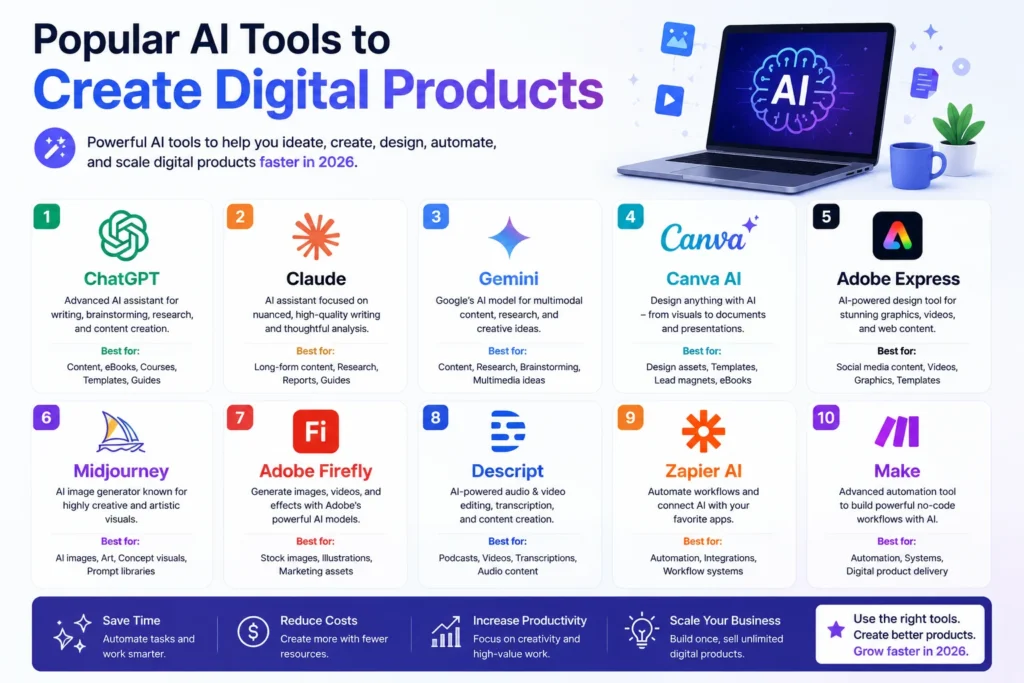
You don’t need a dozen subscriptions to get started. Here’s a simple stack of some of the best AI tools for creators, covering every stage of digital product creation from research to selling.
| Category | Popular AI Tools | What They Help With |
|---|---|---|
| Writing | ChatGPT, Claude, Gemini | Drafting ebooks, courses, scripts, and templates |
| Research | ChatGPT, Claude, Gemini | Market research, outlines, competitor analysis |
| Design | Canva AI, Adobe Express | Templates, brand kits, social graphics |
| Images | Midjourney, Adobe Firefly | Product mockups, branding visuals, illustrations |
| Video | Descript, Canva AI | Course videos, demos, editing, and captions |
| Automation | Zapier AI, Make | Delivery, follow-up emails, support automation |
| Landing Pages | Notion, Carrd | Simple sales pages and lead capture |
| Selling Platforms | Gumroad, Lemon Squeezy, Shopify | Hosting, checkout, payments, delivery |
Most successful creators don’t use every tool in this stack from day one. Start with one writing tool (ChatGPT or Claude), one design tool (Canva AI), and one selling platform (Gumroad or Lemon Squeezy), then add automation and image tools as your product line grows.
How to Choose the Right AI Digital Product Idea
Picking the right idea matters more than picking the trendiest one. Use this five-step framework to land on a digital product you can actually create and sell.
- Identify your expertise. What do you already know how to do that someone else would pay to learn? Look at your job history, hobbies, and the questions people regularly ask you for help with.
- Find audience problems. Spend time in forums, Facebook groups, Reddit threads, and comment sections in your niche. Recurring questions and frustrations are product ideas in disguise.
- Validate demand. Search for existing products solving similar problems. If competitors exist and are selling, that’s a sign of demand, not a reason to avoid the idea.
- Create a minimum viable product. Build the smallest version that delivers real value, such as a short ebook, a 10-template pack, or a five-lesson course, using AI to speed up production.
- Improve using feedback. Launch to a small audience first, collect feedback, and use AI to quickly revise and expand the product based on what real buyers say.
Mistakes Beginners Make When Creating AI Digital Products
Most underperforming AI digital products share the same five problems.
- Creating without research. Building a product based on assumptions instead of checking what your audience actually struggles with.
- Selling generic AI content. Publishing raw, unedited AI output that reads the same as thousands of other AI-generated products on the market.
- Ignoring branding. Skipping a proper cover, consistent visual style, or clear positioning, which makes a product look unfinished and harder to trust.
- Not building an audience. Launching a product with no one to tell about it, then expecting search traffic alone to generate sales.
- Not solving a real problem. Creating something interesting to make rather than something people are actively trying to solve.
Avoiding these five mistakes puts you ahead of most beginners before you even launch.
How to Sell AI Digital Products Successfully
Creating the product is half the work. Getting it in front of buyers is the other half.
Where to sell digital products online:
- Your own website. Gives you full control over branding, pricing, and customer data.
- Gumroad. Simple setup with built-in checkout, popular for ebooks, templates, and prompt packs.
- Lemon Squeezy. Handles global tax compliance automatically, useful once you start selling internationally.
- Shopify. Better suited for creators selling digital products alongside physical merchandise.
How to market AI digital products:
- SEO. Write articles, like this one, that answer the questions your ideal customers are already searching for.
- LinkedIn content. Especially effective for B2B digital products like templates and automation kits.
- YouTube. Demonstrate your product in action. Tutorials build trust faster than ads.
- Email newsletter. Often your highest-converting channel once you have one, since subscribers already trust you.
- Community building. A small, engaged community on Discord, Skool, or in a Facebook group creates repeat buyers for future products.
Want to Build Your Own AI Digital Product Business?
Reading about these 10 product ideas is the first step. Turning one of them into an actual product, researched, built, and launched, is where most beginners get stuck.
That’s exactly what Digital Product Business with AI is built to help with.
Inside, you’ll learn how to:
- Find profitable AI product ideas that match your skills and your audience’s real problems
- Create products faster using AI-powered research, writing, and design workflows
- Build repeatable systems, so your second and third products take a fraction of the time your first one did
- Launch with confidence using proven pricing, positioning, and platform setups
- Grow an AI-powered online business that compounds over time instead of starting from scratch with every new product
If you’ve read this far, you already have the curiosity and a few ideas worth testing. This ebook gives you the system to turn them into a real product.
Get “Digital Product Business with AI” →
Get 50 Free AI Prompts for Digital Product Creation
Before you go, grab a free resource that pairs directly with everything covered above: a pack of 100 AI prompts organized specifically for digital product creators.
Inside the free prompt pack, you’ll find:
- Product research prompts to uncover audience problems and validate ideas
- Ebook creation prompts for outlines, chapters, and editing
- Template creation prompts for business systems, SOPs, and Notion templates
- Marketing prompts for social posts, captions, and content calendars
- Sales copy prompts for product descriptions and landing pages
- AI automation prompts for workflow design and setup documentation
These are the same categories of prompts referenced throughout this article.
Download the free 50 AI Prompts pack →
Frequently Asked Questions
What digital products can I create using AI?
You can create ebooks and guides, prompt packs, Canva templates, online courses, business templates, image prompt libraries, Notion templates, content packages, career products, and automation kits, all using AI tools for research, writing, and design.
Can beginners create digital products with AI?
Yes. AI tools like ChatGPT, Claude, and Canva AI handle much of the research, drafting, and design work, which means beginners no longer need advanced writing, design, or coding skills to create a first product.
What AI tools are best for creating digital products?
ChatGPT and Claude are best for writing and research, Canva AI for design, Midjourney or Adobe Firefly for images, Notion AI for templates and systems, and Zapier or Make for automation.
Are AI digital products profitable?
They can be, but profitability depends on solving a real problem and reaching the right audience, not on the product being “AI-made.” Well-researched, well-marketed digital products in any category can generate income, while generic AI content rarely does.
How can I sell AI-generated products online?
Most beginners start with platforms like Gumroad or Lemon Squeezy for easy setup, then add a personal website as they grow. Pairing this with SEO content, social media, and email marketing helps products reach buyers consistently.
How much can you earn selling digital products?
Earnings vary widely and depend on your audience size, niche, and pricing. Some creators earn a modest amount from their first product, while others build a meaningful income over time. There’s no guaranteed outcome, but consistent, well-marketed products can become a real revenue stream.
Conclusion: AI Is Your Creation Partner, Not Your Competition
AI isn’t replacing digital product creators. It’s removing the barriers that used to keep people from starting in the first place. Research, writing, design, and even automation are now accessible to anyone willing to learn the basics, which is part of why an online business with AI is no longer reserved for people with technical backgrounds, large teams, or big budgets.
The path forward is straightforward:
- Start small. Your first product doesn’t need to be perfect. It needs to exist.
- Solve real problems. Choose ideas based on what your audience is actually struggling with, not what sounds impressive.
- Use AI strategically. Let it handle speed and structure while you add expertise, judgment, and your own voice.
- Build digital assets. Each product you create becomes a foundation for the next one, and the system gets faster every time.
Whether this becomes an AI side hustle alongside your current work or your main online business, the tools and frameworks in this guide put a working digital product business within reach.
Get “Digital Product Business with AI” → for the complete step-by-step system, and grab the free 50 AI Prompts pack → to start building your first product today.