How to Build and Sell Digital Products Faster Using AI Tools in 2026
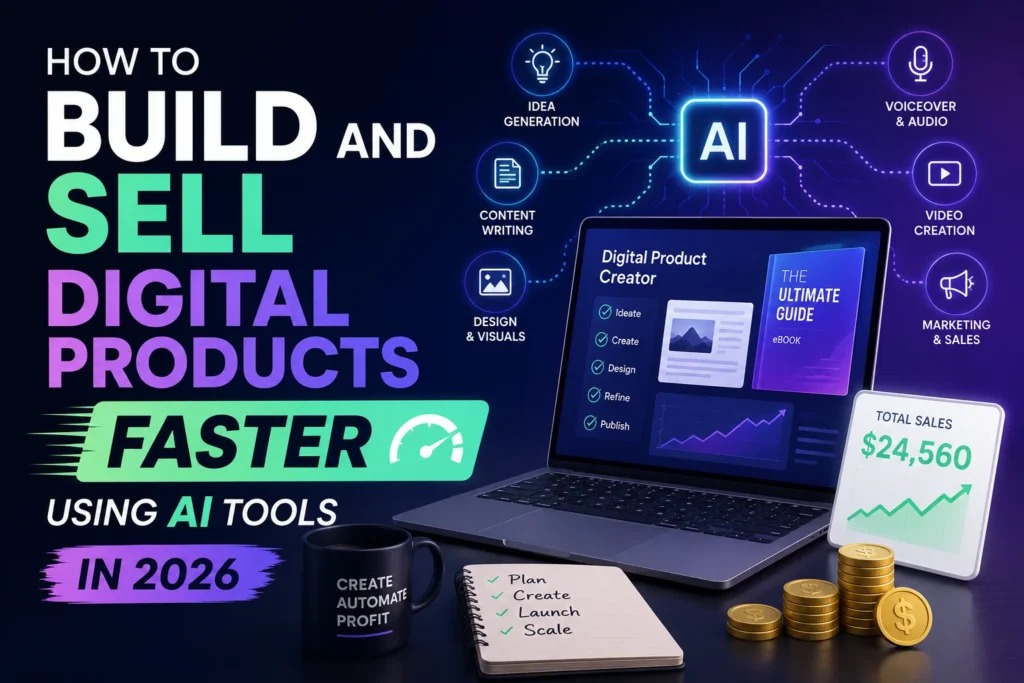
How to Build and Sell Digital Products Faster Using AI Tools in 2026
A comprehensive guide for solopreneurs, creators, and digital entrepreneurs ready to build AI-native income systems.
The Creator Economy Has a New Operating System
In 2026, the gap between creators who leverage AI and those who don’t isn’t a gap anymore — it’s a canyon.
Traditional digital product creation used to look like this: months of research, weeks of writing, days of design, and then the brutal slog of marketing a product to an audience you’d spent years building. Burn rate was high. Output was slow. Income was inconsistent. For every creator who broke through, thousands more burned out before they ever saw traction.
That model is over.
Today, an AI-native creator can validate a niche, build a complete digital product, generate branded assets, set up an automated sales funnel, and publish across multiple platforms — in a single focused weekend. The AI software economy surpassed $184 billion globally in 2026. Over 14,200 active AI tools now exist across content, automation, design, and business operations. McKinsey reports professionals save an average of 37% of their working time using AI systems. AI-assisted product asset creation speeds have increased by 52%. And 88% of businesses using advanced AI workflows reported direct revenue growth.
If you’re still building digital products the old way — linear, manual, slow — you’re competing in a market that has fundamentally rewritten its rules without telling you.
This guide exists to change that. Whether you’re a solopreneur, a freelancer exploring passive income, a coach packaging your expertise, or a digital marketer building scalable income systems, you’ll leave with a clear, actionable roadmap for building and selling digital products using AI in 2026.
If you want the complete blueprint, execution system, and AI prompt library behind all of this — the eBook Digital Product Business with AI covers every step in granular, implementable detail.
AI-Driven Market Research — Finding Profitable Niches in Hours, Not Weeks
The most expensive mistake in digital product creation isn’t poor execution. It’s building the wrong product for the wrong market.
AI has fundamentally changed how smart creators validate ideas before writing a single word.
Step 1: Micro-Niche Discovery with AI Search Analysis
Generic niches are over. “Productivity templates” is saturated. “Notion templates for solopreneur project management workflows” is a micro-niche with real buyers, lower competition, and a specific enough pain point to convert.
Modern AI workflows for digital product creation allow you to analyze conversational search data, identify underserved audience segments, and map demand curves in ways that would have required a full research team three years ago.
AI-assisted niche research workflow:
- Use an LLM (Claude, ChatGPT, or Perplexity) with a structured research prompt to generate 15–20 micro-niche variations within a broad vertical
- Feed those niches into a semantic keyword tool to analyze AI Overview presence, question frequency, and traffic intent
- Cross-reference with Reddit threads, Quora questions, and YouTube comment sections to extract real audience language and recurring pain points
- Use review-scraping prompts to analyze top-selling products on Gumroad, Etsy, and Amazon for common complaints and unmet requests
- Rank your shortlist by demand strength, competition density, and monetization potential
Step 2: Demand Validation Before You Build Anything
AI systems can now run competitor gap analysis in minutes. You can extract what the top-selling products in your niche are missing, what buyers are complaining about in reviews, and what questions remain unanswered — all before committing a single hour to building.
The validation framework:
- Pain-point extraction: Mine Amazon reviews, Reddit posts, and niche forums for recurring frustrations using structured AI prompts
- Trend forecasting: Tools like Perplexity AI and Google Trends AI integrations surface emerging demand signals 6–12 months before they peak in traditional search data
- Audience language mapping: Extract the exact vocabulary your target buyer uses. This directly informs product copy, positioning, and conversion language.
- AI niche research systems: Use prompt chaining to build a layered research report — broad category overview → sub-niche breakdown → buyer persona → top 10 competing products → gap analysis
This entire research phase — which once consumed 2–3 weeks — now takes 2–3 hours with disciplined AI product validation methods.
→ The eBook Digital Product Business with AI includes a complete AI research prompt stack for niche discovery, validation, and competitive analysis — ready to copy and run.
Rapid Digital Product Creation Using AI Tools
Once you’ve validated your niche, the real competitive advantage of AI-native workflows kicks in: speed of creation without sacrifice in quality.
What You Can Build with AI in 2026
The modern AI-powered creator has access to a full production stack for virtually every digital product format:
| Product Type | Primary AI Tools |
|---|---|
| eBooks & long-form guides | Claude, ChatGPT, Canva AI |
| Prompt packs & libraries | Structured prompt engineering |
| Notion templates & systems | AI architecture generation + Notion |
| Canva design templates | Canva AI, Adobe Firefly |
| Online courses & cohorts | Descript, ElevenLabs, Synthesia |
| Swipe files & resource libraries | AI research + human curation |
| Digital planners & workbooks | Canva AI + PDF export automation |
| Automation kits | Make.com + AI orchestration |
| Faceless video content | Runway, Kling, HeyGen |
Click here to read the full blog post and discover 10 digital products you can create with AI tools to start building your online income.
The Modular AI Product Creation Workflow
The key to using agentic AI to build digital assets isn’t using one tool — it’s building a modular creation pipeline where each stage feeds the next.
Phase 1 — Structure Generation Use an LLM to generate a comprehensive outline based on your validated niche research. Include target audience pain points, key transformation promises, and chapter architecture. A well-structured outline prompt is the foundation that determines product quality.
Phase 2 — Prompt Chaining for Content Development Instead of generating an entire product in one prompt, use prompt chaining: each prompt builds on the previous output, maintains voice consistency, and improves depth. This is the core mechanic of AI product creation workflows for serious digital creators.
Phase 3 — Design Asset Generation Feed your content into Canva AI, Adobe Express, or Midjourney with a defined brand aesthetic. Consistent visual frameworks — cover design, section headers, iconography — take minutes using AI, not days.
Phase 4 — Human Refinement Layer Non-negotiable (covered in full in Section 6). Raw AI output needs strategic editing, voice differentiation, experiential depth, and factual verification before it earns the trust of buyers.
Phase 5 — Packaging and Delivery Automation Automate PDF export, product packaging, delivery sequences, and customer onboarding using Zapier, Make.com, or native platform automation tools.
Best AI Tools for Solopreneurs in 2026
Writing & Content Generation:
- Claude (Anthropic) — Superior for long-form, nuanced content and voice consistency
- ChatGPT-4o — Versatile drafting, iteration, and structured output generation
- Jasper — Marketing-specific copy frameworks and brand voice training
Design & Visual Assets:
- Canva AI — Template creation, brand kits, professional document design
- Adobe Firefly — Commercial-safe AI image generation with full IP indemnification
- Midjourney — High-aesthetic visual assets for covers, headers, and brand imagery
Video & Voice:
- Descript — AI-powered video editing, transcription, and voice cloning
- ElevenLabs — Hyper-realistic voice synthesis for course narration and audio products
- Synthesia / HeyGen — Faceless video creation with AI avatars and multilingual support
Automation & Workflow:
- Make.com — Multi-step visual workflow automation without code
- Zapier — Platform integration and trigger-based delivery at scale
- N8N — Open-source agentic workflow systems for advanced multi-agent automation pipelines
AI-Powered Branding & Positioning — Standing Out When Everyone Has the Same Tools
Here’s the central paradox of the 2026 creator economy: AI has made high-quality content easier to produce — which means the bar for differentiation has simultaneously risen. When everyone has access to the same AI content automation systems, the tools themselves can’t be your competitive advantage.
Differentiation has to live in the human behind them.
Building a Unique Position in a Saturated Market
The creators winning in 2026 aren’t producing the most AI content. They’re using AI to amplify a genuinely distinct human perspective.
The positioning formula:
Your niche expertise + your specific audience + your unique named framework = a brand AI cannot replicate
A productivity template creator doesn’t sell “Notion templates.” They sell “the exact workflow system I used to go from freelance chaos to $12K months working 25 hours per week.” That specificity, that origin story, that documented result — AI can assist in articulating it, but it cannot invent it.
Storytelling Frameworks for AI-Era Creators
AI is excellent at structure. It’s poor at texture. Human differentiation strategy means injecting:
- Origin stories — Why you built this, what problem you personally lived through
- Specific results — Real numbers, real timeframes, real client transformations
- Contrarian perspectives — Positions that challenge conventional wisdom in your niche
- Voice signatures — Recurring phrases, frameworks, and worldview that makes your content unmistakably yours and difficult to commoditize
Trust-Building Systems in the AI Era
Audiences are increasingly sophisticated about AI-generated content. Generic listicles and padded guides don’t convert because readers can sense the absence of genuine experience.
Practical trust-building practices:
- Show your process and decision-making, not just the polished output
- Reference specific tools, specific results, specific failures
- Build a community layer — email list, Discord, social following — where your human presence is visible and accessible
- Use AI to produce at scale, but let human judgment govern what gets published and how it’s positioned
Automated Sales Funnels & Digital Product Distribution
Creating a great digital product is only half the equation. The AI-native creator’s real leverage is in automated distribution and sales systems that work while you sleep.
The Step-by-Step Automated Digital Product Funnel
1. Top of Funnel — Traffic Generation AI-optimized content (blog posts, YouTube Shorts, Reels, Pinterest pins) drives organic discovery. The AI SEO strategy behind this is covered in depth in Section 5.
2. Lead Capture — Smart Lead Magnets AI-generated lead magnets — mini-guides, checklists, template samples — capture email subscribers. These can be created, personalized, and A/B tested using AI in hours. The key is matching the lead magnet topic precisely to the pain point that drives search traffic.
3. Automated Email Sequences AI-drafted nurture sequences build trust, address objections, and guide subscribers toward purchase. Platforms like ConvertKit, Beehiiv, and Kit now integrate AI for sequence optimization, subject line testing, and send-time personalization.
4. AI-Generated Sales Page AI-generated landing pages with dynamic copy optimization, social proof integration, and conversion-focused structure. Platforms like Unbounce, Leadpages, and Systeme.io offer AI copywriting built directly into their builders.
5. Checkout & Automated Delivery Once a customer purchases, automated systems handle immediate product delivery, welcome sequences, access provisioning, and receipt generation — without manual intervention.
6. Post-Purchase Upsell Systems AI-powered personalization engines segment buyers by product and behavior, triggering relevant upsell offers for higher-ticket products, bundles, or recurring membership tiers. A well-designed upsell system can increase average order value by 30–60%.
Platform Selection: Which Is Best for Your Stage?
Gumroad — Best for beginners. Zero upfront cost, built-in audience discovery, and immediate payout processing. The lowest barrier to first sale in the digital product ecosystem.
Etsy — Best for template sellers and printable creators. Massive built-in search traffic and a buyer audience actively looking for digital downloads. Competition is intense; strong product thumbnails and SEO-optimized titles are essential.
Shopify — Best for scaling creators who need full brand control, advanced analytics, and customer data ownership. Higher setup complexity but maximum long-term flexibility.
Stan Store — Best for social media creators. Built for link-in-bio storefronts with integrated course delivery, subscriptions, and a clean checkout optimized for mobile traffic from social platforms.
Payhip — Best for creators who want a free-to-start platform with subscription product support, affiliate management, and built-in EU VAT handling.
Lemon Squeezy — Best for digital product sellers and SaaS builders who need robust global tax compliance (automatic VAT/GST handling), subscription billing, and developer-friendly APIs.
Systeme.io — Best for creators building complete automated digital product funnels under one roof — landing pages, email sequences, course delivery, and checkout — at a fraction of the cost of pieced-together alternatives.
→ The Digital Product Business with AI eBook includes a complete platform comparison matrix and step-by-step setup guides for each platform based on product type and growth stage.
AI SEO & Traffic Generation — Ranking in the Age of AI Search
The search landscape has fundamentally changed. The vast majority of informational queries in 2026 are answered by AI-generated summaries before a user ever clicks an organic result. Understanding the new rules of discovery isn’t optional — it’s the difference between consistent organic traffic and publishing in a vacuum.
What Is AI SEO (Answer Engine Optimization)?
AI SEO — also called AEO (Answer Engine Optimization) — is the practice of structuring content to be surfaced, cited, and summarized by AI-powered search systems, including:
- Google AI Overviews — Featured AI-generated summaries appearing above all organic results
- ChatGPT Search — Retrieval-augmented responses citing web sources directly in conversation
- Perplexity AI — In-depth answer aggregation with ranked citations and follow-up queries
- Bing Copilot — Microsoft’s AI-integrated search experience built into Windows and Edge
- Voice search ecosystems — Alexa, Google Assistant, and Siri conversational query handling
Traditional SEO optimized for keyword density, backlink volume, and click-through rates. AI SEO optimizes for semantic relevance, topical authority, and answer-forward content architecture.
How AI SEO Works in 2026: The Core Frameworks
Entity-Based Optimization AI search engines understand entities — people, concepts, products, and relationships — not just keywords. Your content must clearly establish what you are, who you serve, and what specific problems you solve in clear, structured language.
Topical Authority Clusters A single article, no matter how good, cannot establish authority. Build interconnected content clusters — one pillar post supported by 8–12 sub-topic pieces — that demonstrate comprehensive expertise across a niche. AI indexing systems trace these semantic relationships to evaluate topical depth.
Conversational Search Optimization Write the way people speak and query. Use question-format subheadings (“How does AI help solopreneurs build faster?”), direct-answer paragraphs, and FAQ sections that precisely mirror the structure of conversational queries. AI systems extract and summarize this structure directly.
Semantic Internal Linking Connect related content using contextually relevant anchor text. This helps AI search systems understand the full scope of your expertise and builds retrieval-augmented content ecosystems that compound in visibility over time.
The Content Atomization Playbook
Creating content once and distributing it across channels through AI-powered repurposing is how efficient creators build omnipresent organic traffic:
- Core long-form pillar article (primary authority asset)
- → AI extracts key frameworks → Twitter/X thread
- → AI scripts a summary → YouTube Shorts or TikTok breakdown
- → AI rewrites with professional framing → LinkedIn thought leadership post
- → AI designs key data points → Pinterest infographic pins (powerful for AI-assisted search on Pinterest)
- → AI generates editorial commentary → Weekly newsletter issue
- → AI writes hooks and captions → Instagram Reels script
One well-researched piece of content. Seven distribution channels. Months of compounding organic reach.
The Human-in-the-Loop Framework — Why Raw AI Content Fails
This may be the most commercially important section in this entire guide.
AI content saturation is real. Readers, algorithms, and AI systems themselves are increasingly capable of identifying content produced without genuine human expertise, experience, or editorial judgment.
Why Raw AI Content Fails Commercially
- It hallucinates — AI systems confidently produce inaccurate statistics, fabricated citations, and plausible-sounding nonsense that erodes buyer trust the moment it’s discovered
- It’s generic by default — Without strong prompting and human refinement, AI content defaults to the average of everything it’s been trained on. Average doesn’t convert.
- It lacks experiential texture — Readers can sense the absence of real-world experience, especially in business and how-to content where credibility drives purchase decisions
- It underperforms commercially — Generic content doesn’t convert because it doesn’t resonate. Conversion is an emotional response to genuine expertise and trust.
The Human Refinement System: 5 Layers
The winning formula for AI-era digital products isn’t AI versus human. It’s human insight combined with AI execution.
Layer 1: Strategic Direction You provide the niche expertise, competitive positioning, and experiential knowledge that frames the entire product. AI cannot invent your story, your named framework, or your specific documented results.
Layer 2: AI Content Generation With well-crafted prompts, AI handles drafting, structuring, formatting, and production speed. This is where the efficiency advantage lives — but it only works well when the strategic direction is human-led.
Layer 3: Human Editorial Review Every piece of AI-generated content must be reviewed for factual accuracy (especially statistics and external references), voice authenticity, strategic depth, and emotional resonance. This is not optional — it is the quality gate that separates trustworthy products from disposable content.
Layer 4: Storytelling Enhancement Inject personal examples, client results, specific case studies, and contrarian insights that only a human with genuine experience can provide. This layer is what makes your content impossible to commoditize.
Layer 5: Conversion Alignment Ensure every piece of content has a clear, logical next step — whether that’s an email opt-in, a product purchase, a community join, or a follow-up content piece. AI optimizes for completeness; humans optimize for progression.
The creators building the most durable digital product businesses in 2026 treat AI as a highly capable production assistant — not an autonomous content machine. The Digital Product Business with AI eBook is built around this exact philosophy: using AI to eliminate the bottleneck of production without sacrificing the human judgment that drives trust and revenue.
The Future of Agentic AI Workflows — What the Next 18 Months Bring
We are in the early stages of a fundamental restructuring of how expertise is packaged, distributed, and monetized online.
Multi-Agent Automation Systems
Rather than a single AI tool, agentic workflow systems involve multiple specialized AI agents collaborating autonomously — one researches, one drafts, one designs, one optimizes for SEO, one manages distribution triggers. These orchestrated multi-agent automation pipelines are already in use by advanced creators and will become standard infrastructure for serious digital product businesses within 18 months.
What this means for creators: The operational capacity of a solo creator will continue to expand dramatically. A single person with well-designed AI orchestration systems will be capable of producing, distributing, and monetizing at a volume that previously required an entire content team.
AI-Personalized Digital Products
Dynamic digital products that adapt their content based on buyer input, goals, or behavior profiles are emerging as a next-generation format. An eBook that presents different frameworks depending on whether you’re a beginner or an advanced creator — or a course that sequences lessons based on self-reported context — is now technically feasible and will become a competitive differentiator.
Voice-First Content Consumption
AI-powered voice interfaces are making audio-native versions of digital products increasingly important. Course content, guides, and frameworks that can be consumed conversationally — through AirPods, car speakers, or smart home devices — will have a meaningful distribution advantage as voice search ecosystems continue to expand.
The Compound Advantage of Building Now
The most durable advantage available to digital creators in 2026 is not access to AI tools — everyone has that. It is topical authority, built through consistent, high-quality content that establishes genuine expertise in a specific niche over time.
Creators who build comprehensive content ecosystems, authentic positioning frameworks, and AI-powered execution systems this year will be extraordinarily difficult to displace. The window for establishing first-mover authority in AI-adjacent niches is open. It won’t stay open indefinitely.
Conclusion: Your AI-Powered Digital Business Starts With a Decision
The creator economy has never offered more leverage to individual experts, solopreneurs, and digital entrepreneurs. The infrastructure is built. The tools are accessible. The platforms are ready. The demand for high-quality digital products is growing faster than quality supply can meet it.
Here’s what this guide has covered:
- AI-driven market research that identifies profitable micro-niches in hours
- Rapid product creation workflows using modular, prompt-chained AI pipelines
- Positioning strategies that differentiate authentically in a world where AI content is everywhere
- Automated sales funnels that convert traffic into revenue on autopilot
- AI SEO systems built for Google AI Overviews, ChatGPT search, and conversational discovery
- Human-in-the-loop frameworks that produce high-trust, high-converting content at AI speed
The technology is accessible. The opportunity is real. The gap between where you are and where you want to be is not a talent gap or a resource gap. It’s an execution gap — and execution gaps are closed by systems, not by effort alone.
That’s exactly what Digital Product Business with AI delivers.
This isn’t a survey of AI tools. It’s a complete AI business operating system — covering niche validation, modular product creation workflows, positioning frameworks, automated funnel architecture, AI SEO strategy, platform selection guides, and a full prompt library you can use from day one.
If you’re serious about building a digital income system that compounds over time rather than demanding more manual effort with each new product, this is your implementation guide.
→ Get the Digital Product Business with AI eBook and Start Building Today
Frequently Asked Questions
1. Can you legally sell AI-generated digital products?
Yes — in most jurisdictions, AI-generated content created using commercially licensed AI tools (such as ChatGPT, Claude, or Canva AI) can be legally sold as a digital product. However, you must review the terms of service of each specific AI tool you use, as policies vary significantly. Some grant full commercial rights by default; others have restrictions on commercial use or specific product categories. The Digital Product Business with AI eBook covers the current legal landscape in detail, including copyright considerations, platform policies, and recommended licensing practices for 2026.
2. What are the best AI tools for creating digital products in 2026?
The optimal stack depends on your product type, but a high-functioning foundation includes Claude or ChatGPT for content generation, Canva AI for design assets, ElevenLabs for voice synthesis, Descript for video editing, and Make.com or Zapier for delivery automation. For product hosting, Gumroad is the most beginner-accessible option; Lemon Squeezy handles global tax compliance best; Systeme.io offers the most complete funnel infrastructure. The eBook includes a full tool comparison matrix organized by product category and budget tier.
3. How do AI workflows help solopreneurs compete with larger teams?
AI content automation systems compress the time required for research, writing, design, and marketing by 30–50% on average, depending on product type. For solopreneurs, this means running a complete digital product business — including content marketing, funnel management, and customer communication — without hiring staff. The critical practice is building repeatable, documented AI workflows rather than using AI reactively and inconsistently.
4. Can beginners make money selling AI-generated templates?
Yes — but success requires more than AI generation alone. The template sellers consistently generating revenue understand their buyer’s specific workflow frustrations, create templates that solve a narrow, urgent problem, position them with clear value communication (“this saves you 4 hours per week”), and distribute on platforms with existing buyer traffic. AI accelerates production capacity; strategic positioning and distribution drive revenue.
5. What is an AI-native business model?
An AI-native business model is designed from the ground up around AI-powered creation, automation, and distribution — rather than retrofitting AI into a traditional workflow. This means using AI systematically for research, content creation, asset design, customer communication, funnel optimization, and analytics in an integrated pipeline. The result is a business that scales without proportional increases in time investment — the defining characteristic of a true passive income system.
6. How does AI SEO work in 2026?
AI SEO (Answer Engine Optimization) optimizes content to be cited, summarized, and surfaced by AI-powered search systems including Google AI Overviews, ChatGPT search, and Perplexity. The core practices are: building topical authority through interconnected content clusters, using question-format subheadings and direct-answer paragraphs, entity-based optimization, semantic internal linking, and FAQ sections designed to match conversational query patterns. Content structured for AI summarization tends to perform better in traditional organic results as well.
7. What digital products sell best using AI tools in 2026?
The highest-converting AI-assisted digital products include AI prompt packs and libraries, Notion and productivity templates, faceless content systems and automation kits, niche-specific eBooks and guides, Canva template bundles, online courses, and marketing swipe files. Products that solve specific, urgent, clearly-defined workflow problems for a target audience consistently outperform generic alternatives regardless of how they were created.
8. How long does it take to build a digital product with AI?
With a validated niche, a properly structured AI creation workflow, and a disciplined human refinement process, a quality 30–50 page eBook can be drafted in 1–2 days and refined to a publishable, commercially viable standard in another 1–2 days. Prompt packs and template collections can be production-ready in under 8 hours. The bottleneck in 2026 is no longer creation speed — it’s strategic positioning and distribution clarity.
9. Which platform is best for beginners selling digital products?
Gumroad is the most accessible starting point: no upfront cost, simple product upload flow, built-in discovery audience, and immediate payment processing with low fees. Stan Store is the preferred option for creators with an existing social following who need a clean, mobile-optimized link-in-bio storefront. Etsy provides the highest volume of built-in buyer traffic for template and printable products but requires optimized listings to compete. The right choice depends on where your audience already lives and searches.
10. What is the difference between AI-generated and AI-assisted content?
AI-generated content is produced entirely by an AI system with minimal human direction or refinement. AI-assisted content uses AI as a high-speed production tool while human expertise drives strategy, adds experiential depth, fact-checks for accuracy, and injects authentic voice and specific insights. The distinction matters commercially: AI-generated content tends to be generic and lower-converting; AI-assisted content, executed through the human-in-the-loop framework, combines the production efficiency of AI with the trust-building depth that drives purchases.
11. Do I need technical skills to build a digital product business with AI?
No technical background is required. The modern AI creator stack is designed for non-technical users. Canva, Gumroad, Systeme.io, and Make.com all operate with no-code interfaces. LLMs like Claude and ChatGPT require no programming knowledge — only clear, well-structured prompts. The most valuable skill set isn’t technical. It’s the ability to identify real market problems, communicate solutions with specificity, and apply strategic thinking to positioning and distribution.
12. How do I stand out when every creator is using the same AI tools?
Differentiation in the AI era comes from what AI cannot replicate: your specific documented expertise, your results, your named frameworks built from real-world experience, your community relationships, and your strategic positioning within a niche. The creators building durable digital product businesses in 2026 use AI to execute at scale while ensuring their human perspective, origin story, and genuine insight are unmistakably present in everything they publish. That combination — AI execution speed with human intellectual depth — is the competitive moat that compounds over time.
Ready to move from concept to revenue with a complete AI-powered digital product system?
Digital Product Business with AI is your step-by-step implementation guide — including a full AI prompt library, modular creation workflow templates, platform setup walkthroughs, funnel architecture blueprints, and AI SEO frameworks. Everything you need to build, launch, and scale a digital product business that runs on AI-powered systems rather than constant manual effort.
→ Get the Digital Product Business with AI eBook and Build Smarter