What Is an AI Digital Product Business? A Beginner’s Guide to Building Online Products
What Is an AI Digital Product Business? A Beginner’s Guide to Building Online Products
Introduction
AI is changing how people build online businesses. Today, one person can create and sell digital products faster than ever before — without a large team, expensive software, or years of experience.
Not long ago, starting an online business meant hiring designers, writers, and developers. You needed advanced technical skills, costly tools, and weeks — sometimes months — just to get a single product to market. Most people gave up before they even started.
But that’s no longer the case.
After AI, the entire process looks different. You can generate ideas in minutes, write content in hours, design professional visuals without a degree, and market your products with automated copy — all from your laptop. AI hasn’t just made things faster. It has opened the door for an entirely new group of people: beginners, creators, students, and freelancers who were previously locked out of online business.
AI + Digital Products = A New Online Business Model. And right now, the window of opportunity is wide open.
This guide introduces everything you need to understand about this business model. If you want to go deeper and follow a complete system — from choosing your first idea to launching and scaling — check out the ebook Digital Product Business with AI, which helps beginners understand how to create, launch, and sell digital products using practical AI workflows.
Let’s start from the beginning.
What Is an AI Digital Product Business?
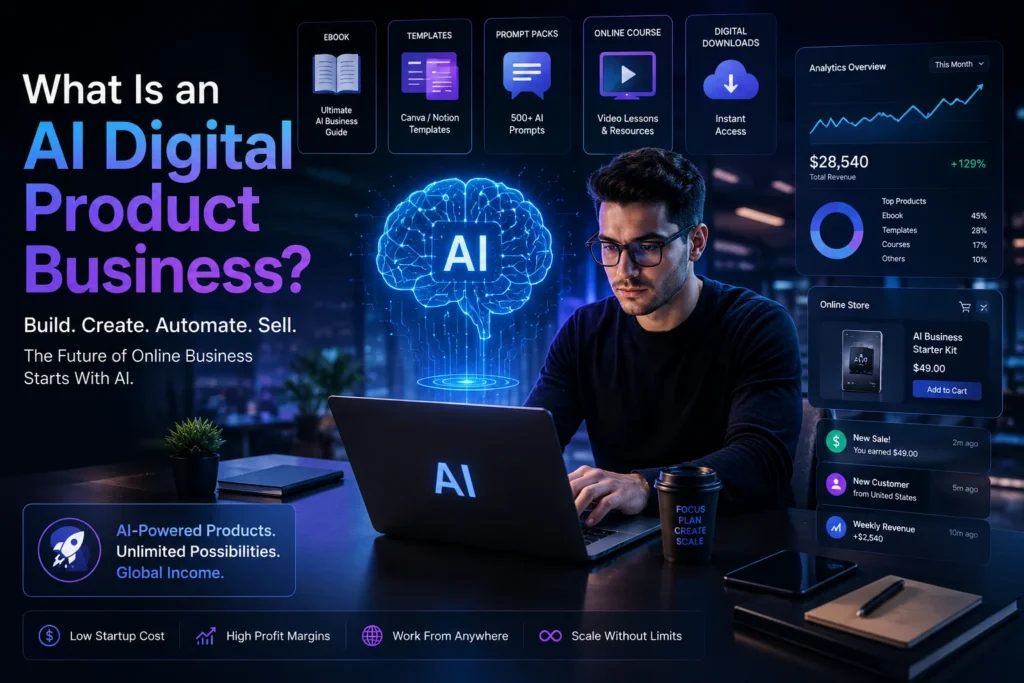
An AI digital product business is an online business model where a creator uses artificial intelligence tools to design, develop, and sell digital products — such as ebooks, templates, courses, or prompt packs — directly to customers anywhere in the world, without needing physical inventory or shipping.
At its core, this business model combines two powerful forces:
- AI tools (like ChatGPT, Canva AI, Jasper, or Midjourney) that help you create content, designs, and marketing materials faster
- Digital products (downloadable or accessible files) that can be sold to unlimited customers without additional production costs
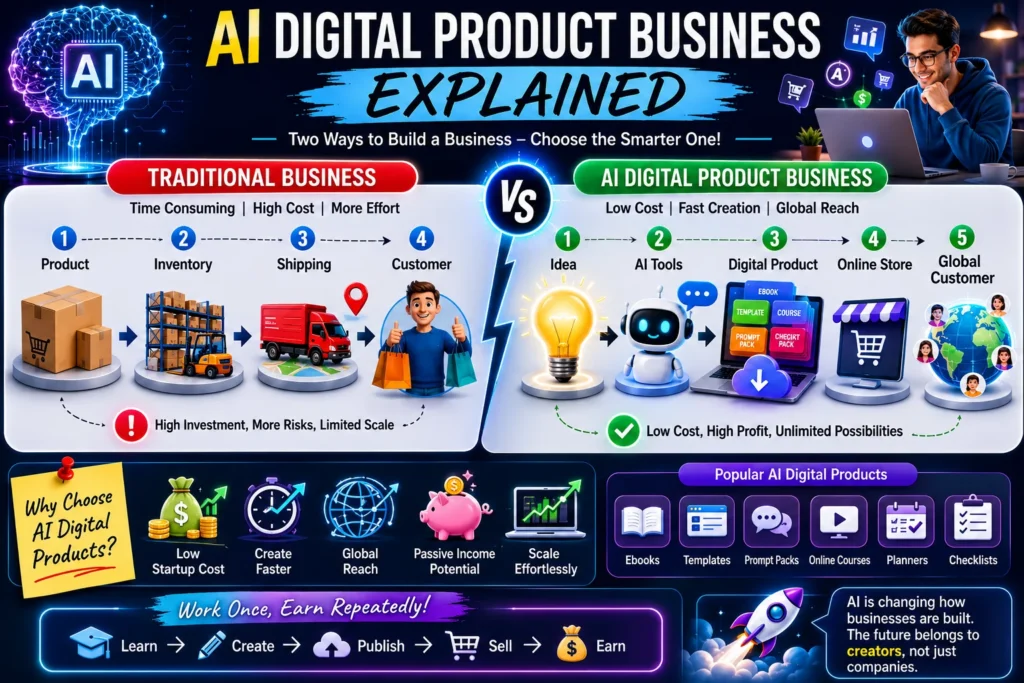
This is fundamentally different from traditional business models:
| Traditional Business | AI Digital Product Business |
|---|---|
| Physical inventory | No inventory needed |
| Shipping & logistics | Instant digital delivery |
| High startup costs | Low or zero production costs |
| Local audience | Global customer base |
| Limited scalability | Unlimited scalability |
| Skilled team required | One person with AI tools |
The “AI” part doesn’t mean the business runs itself. It means AI accelerates what you can do as a creator — helping you research faster, write better, design more, and market smarter — so you can focus on strategy and growth rather than repetitive tasks.
If you want to understand the complete roadmap behind this business model, read: Digital Product Business with AI: Complete Beginner Roadmap
Why AI Digital Product Businesses Are Growing So Fast
This isn’t just a trend. Several powerful forces are converging right now that make this business model one of the biggest opportunities for independent creators.
AI Adoption Is Accelerating
Businesses and individuals worldwide are integrating AI into their daily workflows. According to McKinsey’s research on AI adoption, companies across industries are reporting measurable productivity improvements as AI tools become more accessible and affordable. What once required enterprise-level investment is now available to anyone with an internet connection.
The Creator Economy Is Booming
The global creator economy — individuals who build and monetize content, products, and communities online — has grown dramatically over the past several years. Millions of creators are actively building income streams through digital products, and platforms that support direct product sales have expanded their reach significantly. Reports from the World Economic Forum highlight that digital skills and creator-led businesses are among the fastest-growing segments of the modern economy.
Digital Commerce Continues to Expand
E-commerce isn’t slowing down, and the digital-download segment is growing particularly fast. Consumers have become increasingly comfortable buying digital goods — courses, guides, templates, tools — as they recognize the immediate value of on-demand resources. Global digital commerce projections consistently point to sustained double-digit growth through the late 2020s.
Fewer Barriers, More Opportunity
The combination of these trends means that the time, money, and skill requirements to enter this space are dropping — while the potential audience continues to grow. AI tools specifically help individual creators compete with larger companies by compressing timelines and reducing the cost of production.
For someone starting today, the conditions have never been better.
Explore more possibilities: AI Business Ideas 2026: Opportunities for Beginners
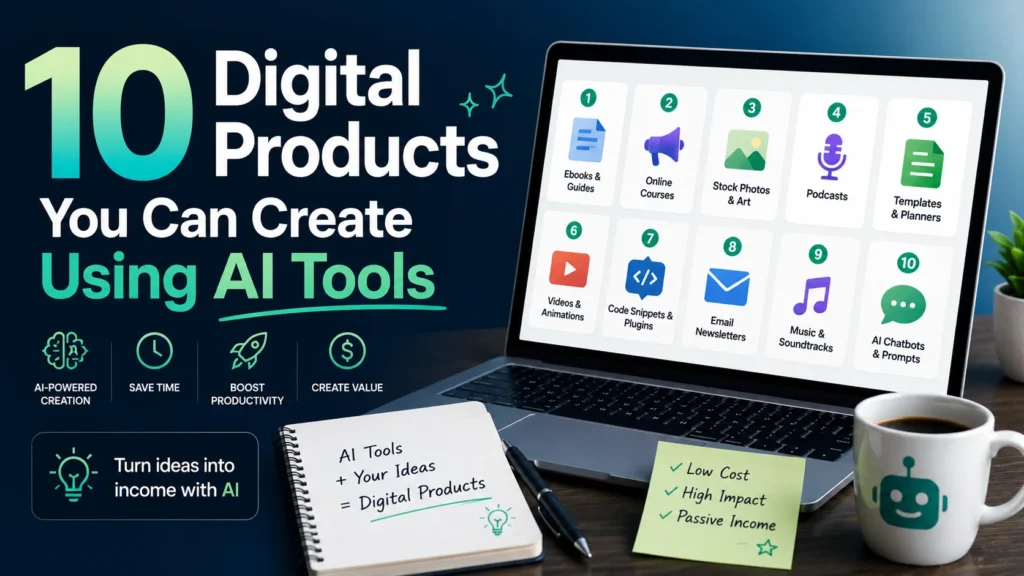
Types of Digital Products You Can Create Using AI
One of the best things about this business model is flexibility. You’re not locked into one product type. Here are the most popular categories and what makes each one valuable.
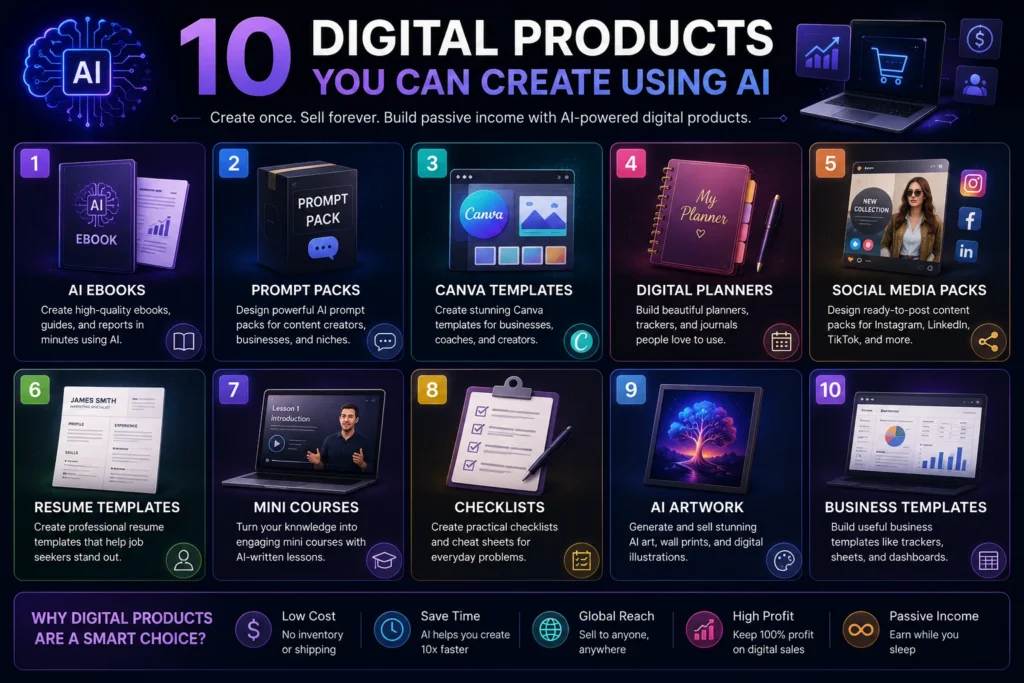
Ebooks
Ebooks are one of the most beginner-friendly digital products available. Using AI, you can research a topic, outline chapters, draft content, and format a professional PDF in a fraction of the time it would take manually. Good ebook topics include how-to guides, step-by-step tutorials, niche educational resources, and beginner roadmaps. A well-targeted ebook on a specific problem can sell for $9 to $49 and reach buyers worldwide.
Prompt Packs
As AI tools become mainstream, demand for ready-made AI prompts has exploded. Businesses, content creators, and students all want proven prompts that save them time. You can create and sell curated prompt packs for specific niches — marketing prompts, writing prompts, image-generation prompts, or business productivity prompts. These are low-effort to produce with AI and high-value to buyers.
Templates
Templates — whether for Canva, Notion, Google Docs, or business use — are consistently in demand. Creators sell social media template packs, resume templates, email newsletter layouts, project management dashboards, and more. AI tools help you generate ideas, write placeholder content, and design visual elements much faster than starting from scratch.
Digital Planners
Productivity planners, habit trackers, goal-setting journals, and daily schedule templates are popular with students, entrepreneurs, and self-improvement audiences. These can be designed in Canva or Notion and delivered as PDFs or interactive files. AI helps with copy, layout suggestions, and naming.
Online Courses
If you have knowledge on a specific topic, AI can help you turn that expertise into a structured course — complete with lesson outlines, video scripts, quizzes, and student workbooks. Courses command higher price points (often $47 to $297 or more) and establish you as an authority in your niche.
Before creating a product, choosing the right product idea is the first important step. Getting this decision right saves you weeks of wasted effort.
See the full list: 10 Digital Products You Can Create Using AI Tools
How AI Helps You Create Better Digital Products
AI doesn’t just save time — it actively helps you create better products than you might produce alone. Here’s how AI supports each stage of the creation process:
Idea Generation: AI can help you brainstorm dozens of product ideas in minutes, based on your niche, audience, and goals. Tools like ChatGPT can analyze trending topics and help you identify gaps in the market.
Content Writing: Whether you need chapters for an ebook, descriptions for a template pack, or lessons for a course, AI writing tools produce solid first drafts that you then refine and personalize. This removes the most common creative block: the blank page.
Research: AI can summarize complex topics, pull key insights from long documents, and help you understand what your target audience is looking for — dramatically cutting research time.
Design: AI-powered design tools like Canva AI, Adobe Firefly, and Midjourney help non-designers produce professional-looking covers, graphics, social media visuals, and product mockups without hiring a graphic designer.
Marketing: AI tools can write email sequences, sales page copy, social media captions, ad copy, and promotional content — consistently and quickly. This removes a major bottleneck for solo creators.
Automation: From email delivery to product fulfillment, AI-connected tools can automate repetitive tasks so you can focus on creating and growing rather than managing logistics.
Discover the tools that make this possible: Best AI Tools for Beginners to Create Digital Products in 2026
The AI Digital Product Business Workflow
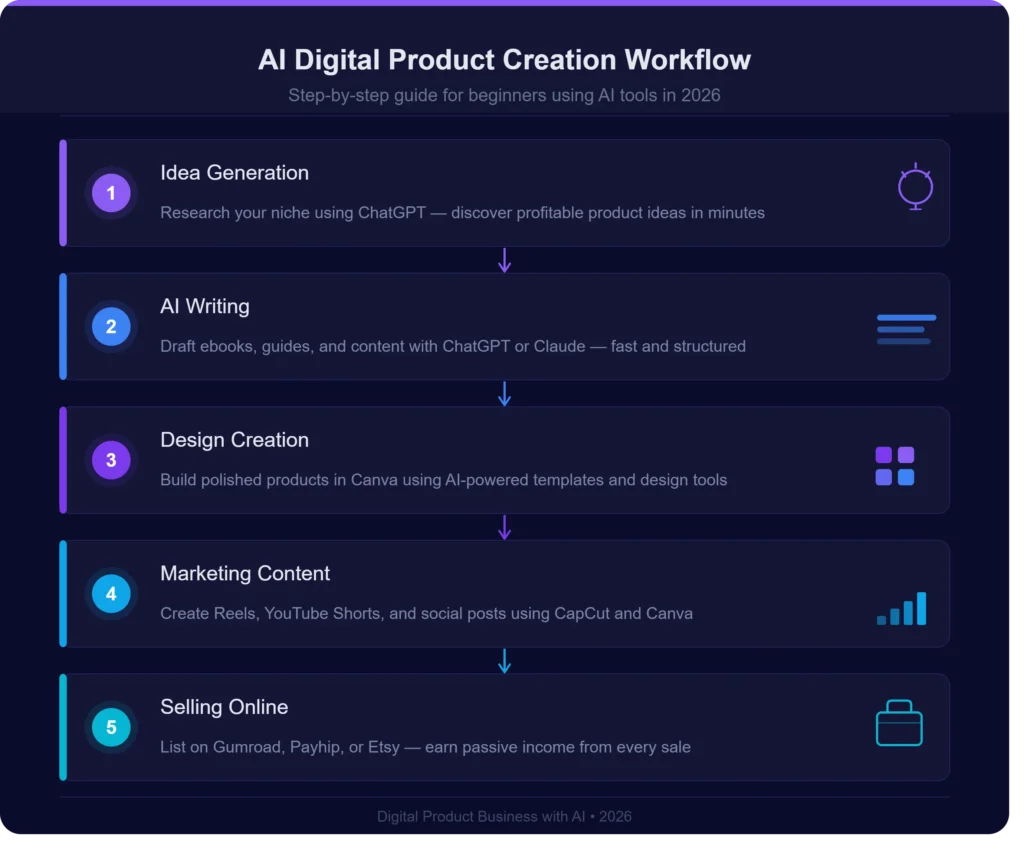
Understanding the workflow helps you move from idea to income systematically. Here is the step-by-step process that most successful AI digital product creators follow:
Step 1 — Idea Choose a specific topic or problem you want to solve. The more targeted, the better. A niche audience with a specific pain point is far easier to serve than a broad, general topic.
Step 2 — Research Validate your idea. Use AI tools and keyword research to confirm there’s real demand. Browse forums, social media, and marketplaces to understand what buyers actually want.
Step 3 — AI Creation Use your preferred AI tools to draft the content, generate design elements, and build the core of your product. Think of AI as a fast-moving creative partner, not a replacement for your ideas.
Step 4 — Design Polish the product. Format your ebook, finalize your templates, or organize your course into a clean, professional presentation. A well-designed product builds trust and increases perceived value.
Step 5 — Marketing Write your sales page, create promotional content, and plan your launch. AI tools help you produce compelling copy and visuals that convert visitors into buyers.
Step 6 — Sell List your product on a platform (Gumroad, Payhip, your own site, Etsy, etc.), set up payment processing, and open for sales. Digital products can begin earning immediately upon launch.
Step 7 — Improve Gather feedback, review analytics, and iterate. The best digital product creators treat their first version as a starting point — not a finished product. Continuous improvement compounds your results over time.
See this workflow in action: My Favorite AI Workflow: Idea → AI → Design → Sell
How You Can Make Money With AI Digital Products
There are several revenue models available in this business, and you don’t have to choose just one.
- Single product sales: Sell one ebook, one template pack, or one prompt collection. Simple, straightforward, and easy to start.
- Product bundles: Group related products together at a higher price point. Bundles increase average order value and give buyers more perceived value.
- Memberships: Offer ongoing access to a library of resources, updated regularly. Members pay monthly or annually, creating predictable recurring income.
- Course programs: Deliver structured learning at a premium price. Courses can be sold as standalone products or bundled with coaching.
- Template libraries: Build a collection of templates that grows over time, attracting buyers who want a comprehensive resource.
It’s important to be honest here: passive income with digital products is real, but it doesn’t happen on its own. It requires quality products that genuinely help people, consistent marketing to reach new buyers, and the discipline to keep creating and improving over time. The “passive” part comes after you’ve done the upfront work.
The good news? AI dramatically reduces how much upfront work is required to reach that point.
Explore monetization strategies: How to Sell Digital Products Online Using AI Marketing Strategies
Who Can Start This Business?
One of the most powerful things about the AI digital product model is that it has an unusually low barrier to entry. You don’t need to be a tech expert, a published author, or an experienced entrepreneur.
Here’s who this works for:
- Beginners with no prior business experience — AI tools flatten the learning curve and make sophisticated tasks accessible
- Content creators who already produce knowledge and ideas but haven’t yet monetized them through products
- Freelancers looking to build income streams that aren’t tied to hours worked or individual clients
- Students who want to build skills, income, and a portfolio simultaneously
- Solopreneurs who want a scalable business without hiring staff
If you can identify a problem, use a simple AI tool, and put a file together — you can start this business.
Find out how: #
Common Myths About AI Digital Product Businesses
A few persistent misconceptions hold people back from getting started. Let’s clear them up.
Myth #1: “AI will replace me as a creator.” Reality: AI is a tool, not a replacement. It amplifies what you already bring — your ideas, your niche knowledge, your voice, your understanding of your audience. The creators who use AI effectively will have a significant advantage over those who don’t.
Myth #2: “I need technical skills to use AI tools.” Reality: The most popular AI tools for digital product creation are designed to be beginner-friendly. If you can type a sentence and click a button, you can use most of them. The learning curve is measured in hours, not months.
Myth #3: “The market is too competitive.” Reality: Yes, there are many digital products available online. But niche products — created for specific, underserved audiences — consistently find their buyers. A generic ebook on “productivity” faces intense competition. A targeted guide for “freelance graphic designers who struggle with client communication” faces almost none.
Avoid the traps that slow beginners down: Beginner Mistakes in Digital Product Business and How to Avoid Them
Skills That Help You Succeed
You don’t need a long list of technical credentials — but certain mindsets and habits will dramatically improve your results.
- Creativity: The ability to see problems, imagine solutions, and present ideas in a way that resonates with your audience is your most valuable asset.
- Problem-solving: The best digital products solve a specific, real problem for a specific, real group of people. Train yourself to think in terms of problems first.
- Research: Understanding your audience — what they struggle with, what language they use, what they’ve already tried — is the foundation of every good product.
- Consistency: Digital product businesses reward creators who show up and keep creating. Building momentum takes time, but the results compound.
- Basic marketing instincts: You don’t need to be a marketing expert, but understanding how to communicate value clearly is essential for turning visitors into buyers.
Learn how AI supports your productivity: How AI Saves 10+ Hours Every Week for Digital Product Creators
How To Start Your First AI Digital Product
Here is a simple beginner roadmap to get from zero to your first product launch:
Step 1 — Choose Your Niche Pick a topic you know something about or are genuinely curious to learn. Ideally, it should intersect with something other people want to learn or improve.
Step 2 — Find a Specific Problem Narrow your niche to a clear, solvable problem. Browse Reddit, Facebook groups, and forums to find questions people keep asking. That’s your product idea.
Step 3 — Decide on Your Product Format Based on your problem and audience, choose a product type — ebook, template, course, or prompt pack. Start simple. An ebook or a small template pack is ideal for your first product.
Step 4 — Use AI Tools to Create It Open your preferred AI tool, describe your product, and start building. Use AI to draft, design, and refine. Your goal is a completed, polished product — not a perfect one.
Step 5 — Launch on a Simple Platform Choose an easy platform to list and sell your product. Gumroad, Payhip, and Etsy are all beginner-friendly options that handle payment processing and file delivery for you.
Step 6 — Gather Feedback and Improve After your first sales, ask buyers for feedback. What did they find most useful? What was missing? Use that insight to improve the product and inform your next one.
Your step-by-step guide: How to Create Your First Digital Product Using AI Step-by-Step
Build Your AI Digital Product Business Step-by-Step
📘 Digital Product Business with AI
If you want a complete system — not just an overview — the ebook Digital Product Business with AI was written specifically for beginners who want to take action.
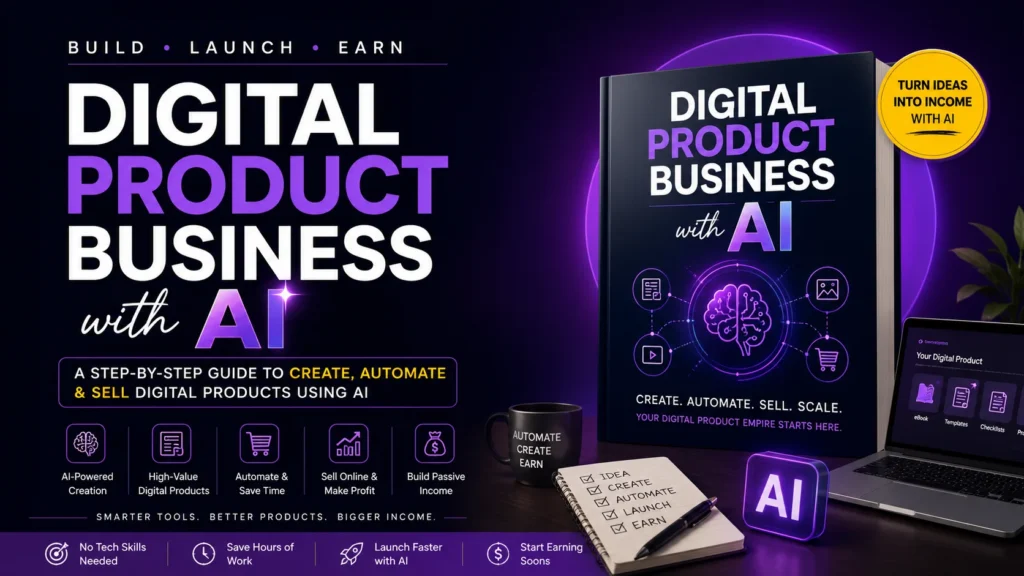
Inside, you’ll discover how to:
✔ Find profitable product ideas that sell
✔ Use AI tools effectively without a technical background
✔ Create high-quality products faster than ever before
✔ Build a repeatable workflow from idea to launch
✔ Market and sell your products to the right audience
Whether you’re starting from scratch or looking to sharpen your approach, this ebook gives you a clear, actionable path to follow.
“Get Digital Product Business with AI and start building your AI-powered online business →
Frequently Asked Questions
1. What is an AI digital product business?
An AI digital product business is an online business where you use artificial intelligence tools to create, market, and sell digital products — such as ebooks, templates, courses, or prompt packs — to customers worldwide. The AI handles time-consuming tasks like writing, research, and design, allowing one person to build and run a product business efficiently.
2. Can beginners create digital products using AI?
Yes. Beginners can create digital products using AI tools with no prior experience in writing, design, or business. Modern AI platforms like ChatGPT, Canva AI, and Notion AI are designed to be user-friendly, and most tasks — drafting content, generating visuals, writing sales copy — can be done without advanced technical skills.
3. What digital products can I sell using AI?
You can create and sell ebooks, prompt packs, Canva templates, Notion templates, digital planners, online courses, business toolkits, and many other downloadable products. The best choice depends on your niche, your audience’s needs, and the format that suits your knowledge.
4. What AI tools are best for creating digital products?
Some of the most useful AI tools for digital product creation include ChatGPT (content writing and ideation), Canva AI (visual design), Jasper or Copy.ai (marketing copy), Midjourney or DALL·E (image generation), and Notion AI (organization and structured content). The right toolkit depends on the type of product you’re building.
5. Is an AI digital product business profitable?
Yes, this business model can be highly profitable — especially because digital products have low production costs and unlimited scalability. However, profitability depends on choosing the right niche, creating genuinely useful products, and consistently marketing them to your target audience. It is not passive income without effort upfront, but the income can become largely automated once your product and systems are in place.
Conclusion
The opportunity in front of independent creators right now is unlike anything that existed even five years ago.
AI gives you speed. Digital products give you scalability. Together, they create a business model that one person — without a large team, without significant capital, and without years of specialized training — can actually build and grow.
But knowing the model isn’t enough. Action is what separates the people who read articles like this from the people who build real income streams.
Start small. Choose a niche. Create one product. Put it out into the world. Gather feedback. Improve it. Create the next one. That’s the compounding cycle that builds lasting digital businesses.
If you’re ready to stop thinking and start doing, the complete system is waiting for you inside the ebook Digital Product Business with AI — your step-by-step guide to building an AI-powered online business from scratch.
The tools are available. The audience is there. The only thing left is your first step.